How to Improve Sleep Quality Naturally (Mattress Included)
Sleep quality is a function of multiple overlapping systems. Circadian rhythm, sleep pressure, stress response, and sleep environment all contribute. A mattress upgrade fits into a specific part of this picture, and understanding where it fits helps set realistic expectations.
"Better sleep" is not one problem. It's a category that includes trouble falling asleep, waking in the night, waking too early, sleeping enough hours but feeling unrestorative, and sleeping well on weekends but poorly on work nights. Each of these has a different cause and a different intervention.
What follows is a framework for thinking about sleep quality from first principles, then placing mattress selection in the right position within that framework. The mattress is real. It matters. But it is one layer in a system, and treating it as the whole solution leads to expensive disappointments.
The two systems that control your sleep
Before troubleshooting sleep, it helps to understand the two biological systems that control it.
System 1: Circadian rhythm. Your body runs on a roughly 24-hour internal clock, regulated by the suprachiasmatic nucleus in the hypothalamus. This clock controls the timing of melatonin release, core body temperature cycling, and alertness hormones like cortisol. It is strongly entrained by light, particularly blue-spectrum light in the morning.
When the circadian clock is well-entrained, melatonin rises in the evening, cortisol drops, and sleepiness builds naturally at a predictable time. When it is disrupted (late light exposure, irregular schedules, shift work, jet lag), the timing signal becomes blurred and sleep onset becomes effortful.
System 2: Adenosine (sleep pressure). Adenosine is a metabolic byproduct that accumulates in the brain throughout the day. The longer you've been awake, the more adenosine has built up, and the stronger the drive toward sleep. Caffeine works by blocking adenosine receptors. Sleep clears adenosine. Napping and sleeping in reduce the pressure available to drive the next night's sleep.
Research: The two-process model of sleep regulation proposes that sleep timing is governed by the interaction between circadian timing (Process C) and homeostatic sleep pressure (Process A). Disruption to either process independently degrades sleep onset and continuity. Most insomnia involves disruption to both. (Borbély A, Human Neurobiology, 1982)
Understanding these systems tells you which levers matter most. Circadian disruption (late screens, irregular wake times) undermines Process C. Excessive caffeine or napping undermines Process A. Stress and anxiety activate the sympathetic nervous system and compete with both processes. The mattress operates at a third level: it determines whether the sleep environment supports or disrupts the sleep architecture that these systems are trying to produce.
The hierarchy of interventions
This ordering is based on the evidence base for chronic insomnia specifically, not just general sleep hygiene. The interventions at the top of the list are the ones with randomized controlled trial evidence for clinically meaningful improvement in insomnia diagnosis. The ones lower on the list have real effects but smaller magnitude.
Consistent wake time: the most underused tool
If you implement one thing, this is it. A fixed wake time, seven days a week, is the most powerful circadian entraining signal available outside of bright light therapy.
The reason this works: if your wake time is consistent, your body learns when to begin its morning cortisol surge (which drives wakefulness) and can therefore also learn when to begin the preceding evening cascade of melatonin and temperature drop. Sleeping in on weekends disrupts this by effectively giving yourself social jet lag: your body's clock shifts later, and Monday night sleep becomes genuinely harder to initiate.
Research: Irregular sleep timing was associated with worse sleep quality, lower academic performance, and altered circadian phase in college students independent of total sleep duration. Social jet lag (difference between weekday and weekend sleep timing) of even one hour produced measurable circadian misalignment. (Phillips AJK, Science Advances, 2017)
Common misconception: "I'll catch up on sleep on the weekend." Catching up on lost sleep does not restore cognitive deficits from sleep deprivation on a one-for-one basis, and the irregular timing creates circadian misalignment that makes the following week's sleep harder. Consistent timing outperforms weekend catch-up by a large margin.
CBT-I: what it is and why it outperforms supplements
Cognitive Behavioral Therapy for Insomnia is a structured treatment that targets the thought patterns and behaviors that maintain chronic insomnia after an initial trigger has passed. It includes:
- Sleep restriction: Temporarily limiting time in bed to match actual sleep time, then expanding gradually as efficiency improves. This sounds counterproductive and is extremely effective.
- Stimulus control: Restricting the bed to sleep and sex only, reducing the conditioned association between bed and wakefulness.
- Cognitive restructuring: Addressing catastrophic thoughts about sleep ("if I don't sleep I'll fail tomorrow") that activate the sympathetic nervous system and prevent sleep onset.
Research: Meta-analyses of CBT-I across multiple populations found it superior to sleep medication for long-term outcomes. Effects are durable (maintained at 12-month follow-up) whereas medication effects typically stop when the medication stops. CBT-I is recommended as first-line treatment for chronic insomnia by the American College of Physicians and the American Academy of Sleep Medicine. (Trauer JM, Annals of Internal Medicine, 2015)
CBT-I does not require a therapist in person. Digital CBT-I programs (Sleepio, SomRyst) have similar evidence bases to in-person treatment for most presentations.
Where the mattress fits in
Once you have addressed the behavioral and timing factors above, the sleep environment becomes the limiting variable. At that point, the mattress matters in specific, predictable ways:
Heat retention delays sleep onset and fragments REM sleep in the second half of the night. This is the most common mattress-related sleep quality issue and is almost entirely a function of mattress construction: foam beds trap heat, hybrid and latex beds do not.
Pressure distribution determines how often your body fires repositioning commands during the night. Too firm for your sleep position and body weight means pressure peaks that generate micro-arousals. Too soft means inadequate spinal support that produces pain.
Motion isolation determines how much of your partner's sleep activity becomes your problem. This is particularly relevant for couples with mismatched sleep schedules or where one partner is a more active sleeper.
Research: A 28-day randomized trial replacing participants' existing mattresses (average age 9.4 years) with medium-firm models found significant improvements in sleep efficiency (+12 minutes per night), back pain severity, and daytime fatigue. Effects were most pronounced in participants whose original mattress showed the most age-related degradation. (Jacobson BH, Journal of Chiropractic Medicine, 2009)
What this means practically: A mattress upgrade is not a sleep cure. But for people who have addressed sleep timing and behavioral factors and still experience fragmented or unrestorative sleep, the mattress is often the remaining variable. Twelve minutes of additional sleep efficiency per night, compounded over a year, is clinically meaningful.
Three picks for overall sleep quality
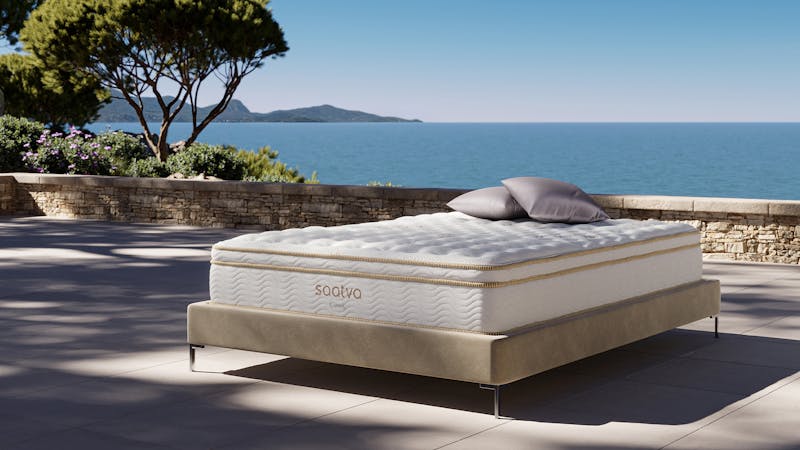
The Saatva is available in three firmness levels (Plush Soft, Luxury Firm, Firm), which matters more than people expect. Matching firmness to body weight and sleep position is one of the most direct ways to reduce pressure-triggered WASO. Luxury Firm works for the widest range of adults. The dual-coil construction provides natural airflow and runs noticeably cooler than foam alternatives. Strong edge support is a practical benefit for getting in and out of bed at night without waking a partner.
The Avocado uses natural Dunlop latex over pocketed coils. Latex is uniquely responsive: it compresses under pressure and springs back immediately, distributing load better than foam for most sleep positions. The natural materials run thermally neutral, without the heat-trapping characteristic of synthetic foam. For people prioritizing materials provenance alongside sleep performance, the certifications (GOTS, GOLS, Greenguard Gold) are the strongest in the industry.
DreamCloud's pocketed coil hybrid with a cashmere euro top consistently tests well across all three mattress quality dimensions: cooler than foam, good pressure distribution at the hip and shoulder, and better motion isolation than most coil beds at its price. For people who want a reliable all-around improvement without optimizing for a specific weak point, the DreamCloud Premier is the most straightforward choice.
Related Reading
Compare top picks side by side →Full ranked list
Best Mattress for Back Pain
See every mattress we tested for back pain, ranked by performance score.
Top Picks for Hot Sleepers
See full list →Ranked by test data
Not sure which mattress is right for you?
Take our 60-second quiz and we'll match you with the best options for your sleep style and budget.
Take the Free Quiz →