Does Mattress Comfort Affect REM Sleep? What Sleep Science Actually Shows
REM sleep is the most physiologically vulnerable sleep stage. Your body stops actively regulating temperature, muscles are paralyzed, and arousal threshold drops. A mattress that traps heat or creates pressure points is most disruptive during exactly this stage.
Of the four stages in a sleep cycle, REM is the one your mattress can hurt the most. That sounds counterintuitive. You'd expect that the deeper the sleep, the more resilient it would be to outside disturbances. But the biology runs the other way. REM has properties that make it specifically vulnerable to the kind of disruptions a mattress can cause.
Understanding why requires a short detour into sleep architecture, because the mechanism matters for knowing what to actually do about it.
How a sleep cycle actually works
Sleep cycles through four stages roughly every 90 minutes. The stages are:
N1: Light sleep. Easy to wake from. Lasts about 5 minutes. Hypnic jerks happen here.
N2: Consolidated light sleep. The most common stage, accounting for about 45 to 55 percent of total sleep time. Sleep spindles and K-complexes occur, both of which play a role in memory consolidation.
N3 (slow-wave or deep sleep): This is the restorative phase where tissue repair, immune function, and growth hormone release are concentrated. Hardest to wake from. Arousal threshold is highest here.
REM: Rapid eye movement sleep. Brain activity resembles wakefulness. This is where most dreaming occurs, where emotional memory processing happens, and where creative and procedural learning is consolidated.
The proportion of these stages shifts across the night. Deep sleep (N3) is concentrated in the first half. REM is concentrated in the second half, with REM episodes getting progressively longer with each cycle. The final REM period before waking can last 30 to 45 minutes.
Why this matters for mattress selection: If a mattress disrupts sleep in the second half of the night, it is disproportionately cutting into REM. That is not the same as losing sleep earlier in the night. The longest, most cognitively significant REM periods are the ones getting truncated.
What makes REM vulnerable
REM has three properties that make it specifically exposed to mattress-related disruptions:
1. Thermoregulation shuts down. During REM, the brain suspends active temperature regulation. You become functionally poikilothermic: your body temperature tracks the ambient environment rather than maintaining a defended set point. This is why the temperature of your sleeping surface matters most during REM. If the mattress is hot, you get hot.
Research: Studies using thermosuit protocols confirmed that external thermal manipulation during REM sleep produced greater arousal responses than during N2 or N3, consistent with the hypothesis that thermoregulatory shutdown during REM makes the sleeping body more reactive to surface temperature changes. (Raymann RJEM, Brain, 2008)
2. Muscles are paralyzed (REM atonia). The brainstem actively inhibits motor neurons during REM to prevent you from physically acting out dreams. The practical consequence is that you cannot reposition to relieve pressure points. During N2 and N3, your body shifts to unload compressed tissue before it reaches the pain signaling threshold. During REM, that mechanism is disabled.
3. Arousal threshold is lower than during deep sleep. Despite the brain being highly active, REM is closer to wakefulness than N3. Disruptions that would not wake you during slow-wave sleep are more likely to produce an arousal during REM.
The combination of these three factors means: heat from the mattress reaches you directly (thermoregulation is off), pressure builds unchecked (you can't reposition), and you're easier to wake (lower arousal threshold).
The sleep architecture diagram
Sleep Stages Over 8 Hours: Where REM Is Most Vulnerable
What REM deprivation actually does
Cutting short REM sleep affects the brain in ways that show up by the next afternoon.
Research: Studies using selective REM deprivation (waking participants each time EEG showed REM onset) produced impairments in emotional regulation, increased reactivity to stressors, and reduced performance on creative problem-solving tasks, independent of total sleep time. Participants with selectively suppressed REM reported equivalent subjective fatigue to participants who lost the same amount of sleep from other stages, but showed greater emotional reactivity on standardized assessments. (Walker MP, Journal of Neuroscience, 2002)
REM is where the brain processes emotionally significant memories, strips emotional charge from difficult experiences, and consolidates creative and associative learning. Missing it does not just make you tired. It makes you more reactive, less adaptable, and slower to recover from stressors. People who chronically get less REM than their biology requires often describe this as feeling "fine but frayed."
Common misconception: "Eight hours of sleep means eight hours of good sleep." Total sleep time is not the same as sleep quality. Someone sleeping on a mattress that fragments the second half of the night can log eight hours and still be REM-deprived. The metric that matters is sleep efficiency: what percentage of time in bed is productive sleep, in the right stages.
The mattress properties that suppress REM
Given what we know about REM's vulnerabilities, the mattress properties that suppress REM are predictable:
Heat retention is the primary one. Because thermoregulation shuts off during REM, a hot mattress directly raises body temperature during REM. This produces arousal responses and shortens REM episodes. This is why hot sleepers so consistently report unrestorative sleep even after adequate hours: they may be cycling through early cycles normally but getting kicked out of late-cycle REM by heat buildup.
Pressure peaks in side positions produce signals the body cannot respond to during REM atonia. The brainstem eventually overrides atonia to reposition, but this produces a full or partial arousal. Waking at 5am with unexplained shoulder or hip pain is often this mechanism.
Motion transfer from a partner can fragment REM across the whole second half of the night. Because REM arousal threshold is lower than N3, the partner movements that someone could sleep through during deep sleep become arousing events during REM.
Three picks designed to protect the second half of the night
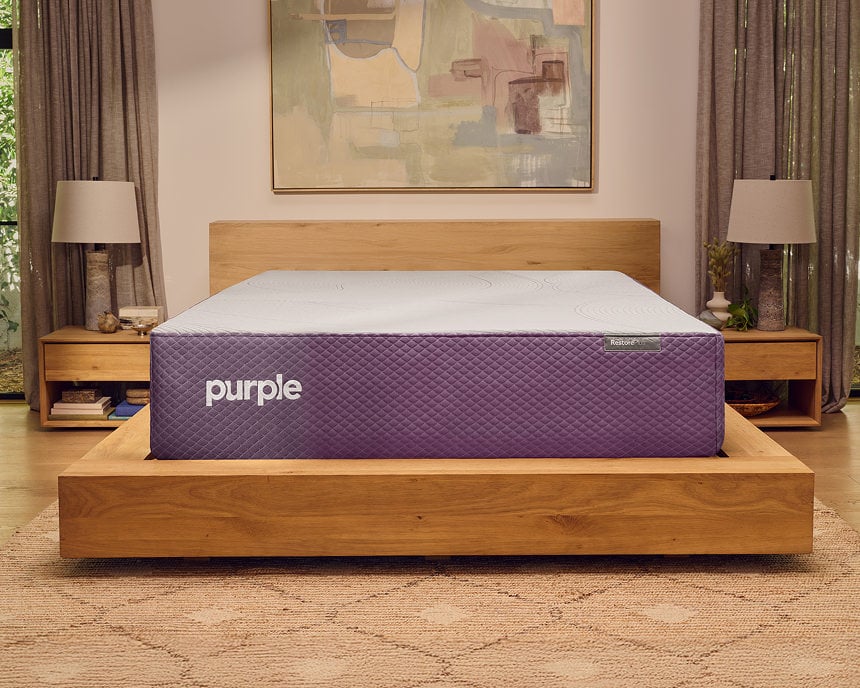
Purple's GelFlex Grid is the most unusual approach to temperature in the industry. Rather than relying on gel-infused foam or copper-infused layers, the grid physically separates your body from the foam below it, creating open air channels across the entire surface. Surface temperature stays noticeably lower than any foam-dominant alternative. For REM disruption caused by heat buildup in the second half of the night, this is the most direct engineering solution available at this price point.
TEMPUR-Adapt uses Tempur-Pedic's proprietary viscoelastic material, which is unusually effective at absorbing and isolating movement. If motion transfer from a partner is the main cause of late-night REM fragmentation, the motion isolation on Tempur material is best-in-class. The trade-off is heat: Tempur-Pedic runs warmer than hybrids, which is why this pick is specifically for people whose primary issue is motion rather than temperature.
The Midnight Luxe addresses all three REM risk factors at once without being best-in-class at any of them: zoned coils reduce pressure peaks at the shoulder and hip, the coil base provides airflow to keep surface temperature lower than foam beds, and the foam comfort layer adds meaningful motion isolation. For people who cannot identify a single primary cause of poor sleep, this is the most reliable all-around choice.
Related Reading
Full ranked list
Best Mattress for Back Pain
See every mattress we tested for back pain, ranked by performance score.
Top Picks for Hot Sleepers
See full list →Ranked by test data
Not sure which mattress is right for you?
Take our 60-second quiz and we'll match you with the best options for your sleep style and budget.
Take the Free Quiz →