Can Your Mattress Cause Insomnia? The Science Behind Sleep Surface and Sleep Onset
A mattress doesn't have to be obviously broken to disrupt your sleep. Subtle factors like surface temperature, pressure distribution, and motion transfer interact with the brain's sleep systems in ways that delay sleep onset and fragment sleep throughout the night.
Sleep onset depends on a set of physiological conditions that need to line up before your brain will let you cross the threshold into unconsciousness. Your core body temperature needs to be dropping. Your nervous system needs to be in parasympathetic mode. There should be no competing signals from pain or thermal discomfort demanding your attention.
Your mattress interacts with all three of those conditions directly. Whether it supports them or works against them has more influence on your sleep than most people realize, and the effects show up not just as trouble falling asleep but as fragmented, unrestorative sleep across the entire night.
Why falling asleep requires more than lying down
Your body doesn't switch into sleep mode the moment you get horizontal. Sleep onset is an active process. The brain needs to:
- Register falling core body temperature, driven by peripheral vasodilation at the hands and feet
- Reduce sympathetic nervous system activity (the alerting system)
- Receive no competing signals from pain, pressure, or thermal discomfort
The transition from wakefulness to sleep takes between 5 and 20 minutes for most healthy adults. When that window regularly extends to 30 or 45 minutes, the pattern is called sleep onset insomnia. The causes are usually something interrupting one of those three conditions. Your mattress can interfere with all of them.
Common misconception: "I just need to relax more." Sleep onset is not passive. It's a coordinated physiological sequence: core temperature drops, sympathetic activity decreases, sleep begins. If your mattress is trapping heat or creating pressure peaks that fire repositioning signals, that sequence gets interrupted before it completes.
The heat mechanism
Sleep onset requires your core body temperature to fall by approximately 1 to 2 degrees Fahrenheit. Your body achieves this by routing blood to the hands and feet, radiating heat outward. This peripheral vasodilation is one of the most reliably measurable signals of imminent sleep.
Research: Experimental studies using a thermosuit to manipulate distal skin temperature found that raising hand and foot temperature by as little as 0.4°C significantly shortened sleep onset latency and reduced nocturnal waking. The mechanism: peripheral warming facilitates the core temperature drop required to initiate sleep. (Kräuchi K, Nature, 1999)
Where does the mattress come in? Your body is trying to radiate heat outward, but a dense foam mattress with low breathability insulates that heat back toward you. If your sleeping surface restricts airflow and retains warmth, the thermal gradient your body needs to dump heat into is compromised.
Traditional memory foam is the most common offender. Its closed-cell structure traps heat in the foam and creates a warm pocket around your body. This is the reason people describe memory foam as sleeping hot, and it is not purely subjective. Interface skin temperature at the body-mattress contact surface is measurably higher on dense foam compared to hybrid or latex under the same ambient conditions.
What this means practically: Studies comparing sleeping surface temperatures found that traditional memory foam raised interface skin temperature by 2 to 4°C more than hybrid mattresses. For someone already prone to difficulty falling asleep, that thermal difference is enough to delay sleep onset by a meaningful margin.
The pressure mechanism
When tissue over a bony prominence is compressed beyond approximately 32 mmHg, local blood flow drops enough to trigger a low-grade ischemic signal. The brainstem registers this as a repositioning command and generates a motor response, often before you are conscious of it at all.
This is the mechanism behind tossing and turning. You are not deciding to roll over. Your brainstem is responding to pressure signals from your hips, shoulders, or lower back and moving the body before you have fully woken up.
Research: Pressure mapping across mattress types found significant variation in interface pressure at the hip and shoulder. Firm surfaces regularly produced peaks above the 32 mmHg capillary occlusion threshold in side-sleeping positions. Softer surfaces distributed load more evenly, keeping pressures below this threshold at those same sites. (Defloor T, International Journal of Nursing Studies, 2000)
The practical consequence: a mattress that is too firm for your body weight or sleep position creates pressure peaks that generate repositioning signals throughout the night. These fragment sleep without necessarily producing full awakenings you would remember in the morning. You wake up tired and don't know why.
The motion mechanism
If you share a bed, your partner's movements are transmitted through the mattress to you. How much gets transmitted depends on the mattress's ability to contain motion within a local area rather than propagating it across the surface.
Interconnected innerspring systems behave like a trampoline: movement in one area propagates across the surface immediately. Individually pocketed coils and foam layers reduce this transmission significantly.
Research: Polysomnographic studies of bed-sharing couples found that partner movements caused measurable EEG arousal events in the other sleeper at rates that varied significantly by mattress type. Traditional innerspring systems produced roughly 2 to 3 times more arousal events per night than pocketed-coil hybrids or foam beds under controlled conditions. (Lichstein KL, Behavior Research and Therapy, 2008)
Worth knowing: Motion transfer is the most underestimated cause of fragmented sleep in couples. Many people diagnose themselves as light sleepers when the actual variable is the mattress transmitting their partner's movements into EEG arousal events they don't fully remember in the morning.
Which factors matter most
What the research says about mattress switching
The challenge with attributing insomnia to a mattress is that people often habituate to their sleep environment and stop noticing problems with it. When researchers have run controlled trials where participants with poor sleep switched from their existing mattress to a medium-firm model, outcomes were measurably positive.
Research: A controlled trial of 59 participants who replaced their mattresses (average age 9.4 years) with medium-firm models found significant improvements in sleep efficiency, reduced back pain, and reduced perceived stress. Sleep efficiency improved by an average of 12 minutes per night, and daily fatigue scores dropped significantly over the 28-day trial period. (Jacobson BH, Journal of Chiropractic Medicine, 2009)
The improvement was not just in reported comfort. Objective sleep measures also improved, which makes a stronger case than self-report alone.
Three picks that address all three mechanisms
The Midnight Luxe is a zoned pocketed-coil hybrid with a thick foam comfort layer. Zoned coils mean the center third is firmer to support the lumbar spine while the shoulder zones are softer, reducing pressure peaks in side sleeping. The coil system creates substantial airflow. For insomnia driven by heat retention and pressure points, this is consistently one of the most effective choices.
DreamCloud's pocketed coil system with a cashmere euro top distributes pressure well across most body types and provides enough coil airflow to stay noticeably cooler than foam beds. Particularly strong on motion isolation for a hybrid at this price point, which makes it a sensible choice for couples where partner movement is a factor.
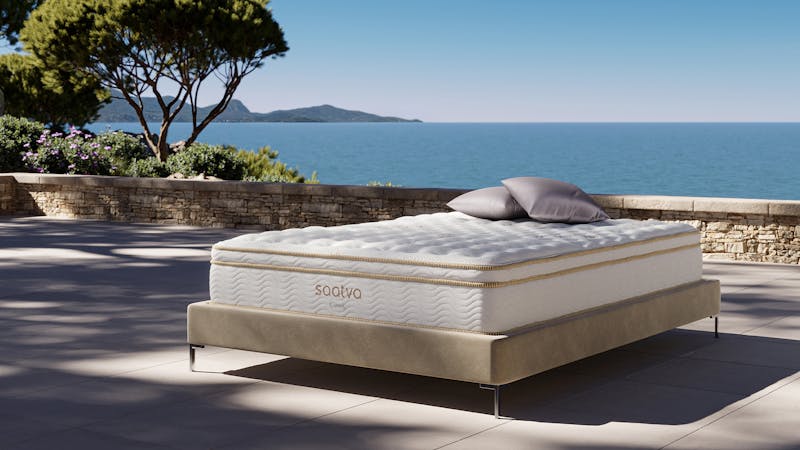
The Saatva uses a dual-coil system with a Euro pillow top and is available in three firmness levels, which matters more than people think for matching surface feel to body weight. The Luxury Firm (their middle option) works for the widest range of sleepers. Good lumbar support, strong edge support, and a surface temperature that runs cool compared to foam alternatives.
Related Reading
Full ranked list
Best Mattress for Back Pain
See every mattress we tested for back pain, ranked by performance score.
Top Picks for Hot Sleepers
See full list →Ranked by test data
Not sure which mattress is right for you?
Take our 60-second quiz and we'll match you with the best options for your sleep style and budget.
Take the Free Quiz →