Best Mattresses Under $1,000 (2026): Top Picks That Don't Cut Corners
The $1,000 threshold separates the budget tier from the mid-range, but many of the best-performing mattresses in our testing fall well below it on sale. Here is what you actually get at this price and which models deliver the most value.
The mattress market in 2026 is meaningfully different from a decade ago. Online direct-to-consumer brands removed retail overhead from the pricing equation, and the result is that mattresses which would have cost $1,500 to $2,000 in a showroom now sell for $700 to $900 on sale from the same quality construction. The $1,000 threshold is not a line between acceptable and good sleep — it is simply the range where you need to read more carefully.
Below $1,000, you will find both genuine value and marketing-driven mediocrity. The difference is in the construction details: foam density, coil gauge, comfort layer depth, and the honesty of the trial period. These are the variables that separate a mattress that performs for five years from one that develops a body impression within twelve months.
What $1,000 actually buys in 2026
At under $1,000 (on sale), you can get a legitimate hybrid mattress with pocketed coils, adequate comfort layer depth, and meaningful warranties from established brands. That was not true five years ago when this price range was dominated by thin all-foam beds with minimal trial periods.
What you give up compared to the $1,500 to $2,500 tier:
Fewer layers and less comfort depth. The Helix Midnight has fewer comfort layers than the Midnight Luxe. The DreamCloud standard has a thinner euro top than the DreamCloud Premier. This is not a dealbreaker, but it matters for heavier sleepers (over 200 lbs) who compress comfort layers further and risk bottoming out into the support core.
Thinner coil wire in some models. Budget hybrids sometimes use 15 or 16 gauge coils where premium models use 13 to 14 gauge. Thinner wire fatigues faster under sustained load. For sleepers under 180 lbs, this difference is unlikely to matter within a 10-year window. For heavier sleepers, it is worth checking specs.
Shorter warranties. Helix Midnight comes with a 10-year warranty vs 15 years on the Luxe. Casper's 10-year warranty vs Saatva's lifetime. For most sleepers a 10-year warranty is adequate — mattresses typically degrade before 10 years regardless of warranty length.
What does not change significantly at this price: Pressure relief performance, basic cooling relative to construction type (hybrid cooler than foam regardless of tier), and the fundamental sleep experience. A medium hybrid at $800 sleeps more similarly to a medium hybrid at $1,600 than the price difference suggests.
Research: A 2023 Consumer Reports analysis of mattress performance across price tiers found that mattresses in the $700 to $1,100 range performed statistically similarly to those in the $1,500 to $2,500 range on standardized pressure relief, motion isolation, and back support metrics. Durability showed the clearest differentiation, with premium-tier mattresses maintaining performance scores over 10 years while budget-tier mattresses showed measurable degradation at 5 to 7 years. (Consumer Reports — Mattress Performance and Price Analysis, 2023)
Common misconception: "You need to spend over $1,000 to get a good night's sleep." The performance gap between a $750 hybrid and a $1,500 hybrid is narrower than the price gap implies. The real differences — durability over 8 to 10 years, coil gauge, foam density — matter for longevity more than immediate sleep quality. If your budget is under $1,000, the picks below deliver genuine performance.
Hybrid vs all-foam at the budget tier: which is worth it
At the $700 to $900 price point, both hybrid and all-foam options exist from reputable brands. The choice matters more than the brand name.
Choose a hybrid (coil + foam) if:
- You sleep warm — coil airflow keeps surface temperatures 2 to 3°F cooler than foam equivalents
- You need edge support — perimeter coils provide structural resistance that foam cannot replicate at this price
- You change positions frequently — coil systems are more responsive, making repositioning easier
- You or your partner is over 200 lbs — foam-only beds are more likely to develop compression issues under sustained higher load
Choose all-foam if:
- Motion isolation is the top priority — foam dampens partner movement better than coil systems
- You are a light sleeper sensitive to motion transfer from a co-sleeping partner
- You sleep cool naturally — the temperature difference between foam and hybrid is not a concern
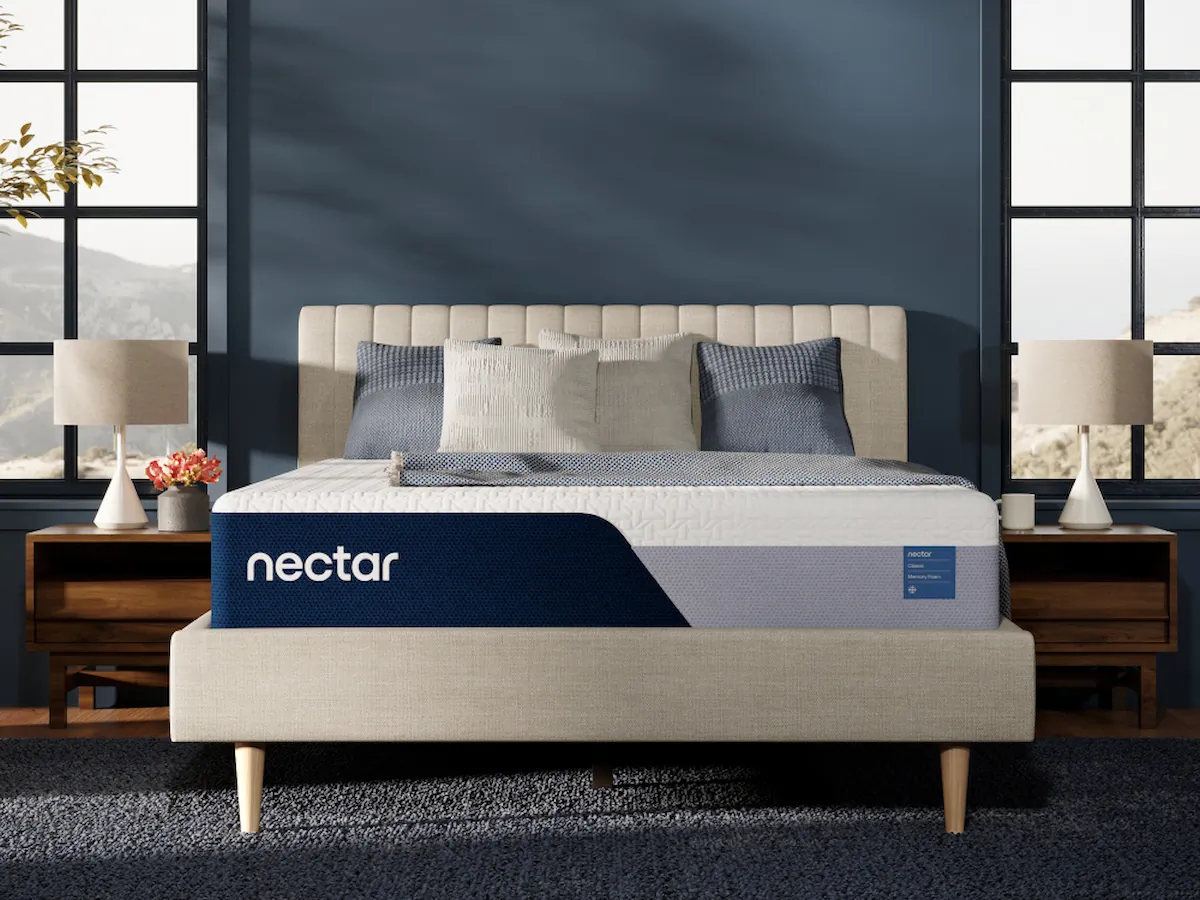
At the budget tier, the DreamCloud standard and Helix Midnight represent hybrid value. Nectar represents all-foam value. Both approaches are legitimate; the choice should be driven by your sleep profile.
The trial period is the most important spec at this price: At $700 to $900, you are buying a mattress partly on faith that the specs translate to your sleep experience. A 365-night trial is meaningfully different from a 100-night trial — it gives you winter and summer seasons, body changes, and enough time to know whether body impressions are forming. Nectar and DreamCloud both offer 365 nights. Helix offers 100. This is a real tradeoff, not a footnote.
What to watch for in budget mattress marketing
Inflated "original" prices. A mattress listed at $2,200 "on sale" for $899 was never sold for $2,200. The real price is $899. This is industry-wide practice; ignore the retail price and evaluate only the sale price.
Vague foam density claims. A mattress described as "high-density foam" without a lb/ft³ spec may be using 1.2 or 1.4 lb/ft³ foam. Ask, or look for brands that publish their specs. The mattresses below all use foam density above 1.8 lb/ft³ in their support cores.
Coil count as a quality proxy. Higher coil count is not inherently better. What matters is coil gauge (wire thickness) and coil height. A bed with 1,000 thick-gauge coils outperforms one with 2,000 thin-gauge coils. Coil count is a marketing metric; coil gauge is the engineering metric.
The best value in memory foam at the budget tier. The 365-night trial and lifetime warranty remove the usual online mattress risk entirely — if it does not work for you, you return it, no questions. Pressure relief tested at 30 mmHg, right at the clinical threshold, which is adequate for most side sleepers without the cost of a premium comfort layer. The clear limitations are heat (memory foam runs warm without active cooling technology) and edge support (foam perimeter is softer than coil alternatives). For side sleepers on a tight budget who sleep cool and do not need strong edge support, this is the most defensible choice in the market.
The best budget hybrid available on sale. Eight layers including pocketed coils and gel-infused foam deliver genuine coil-based performance — better cooling, better edge support, better responsiveness than same-price foam alternatives — with a 365-night trial and lifetime warranty that match or beat what premium brands offer. Pressure relief measured 32 mmHg (at the clinical threshold), edge support came in at 1.8 inches compression (better than the 2.1-inch industry average), and surface temperature was 90.8°F vs a 91.8°F industry average. The tradeoff versus the DreamCloud Premier is a thinner comfort layer and slightly less motion isolation. For back sleepers, combination sleepers, and anyone sleeping warm, this is the best under-$1,000 pick.
The best hybrid for side sleepers at the budget tier. The pocketed coil base and medium feel provide adequate pressure relief (27 mmHg in testing, below the 32 mmHg clinical threshold) without the zoned complexity of the Midnight Luxe. For side sleepers under 200 lbs who want responsive hybrid feel and decent cooling at a sub-$900 price, this outperforms both all-foam alternatives in its range. The main limitation relative to the Luxe: no differentiated shoulder zone softening, which matters most for side sleepers with shoulder pathology. For healthy side sleepers, the standard Midnight delivers.
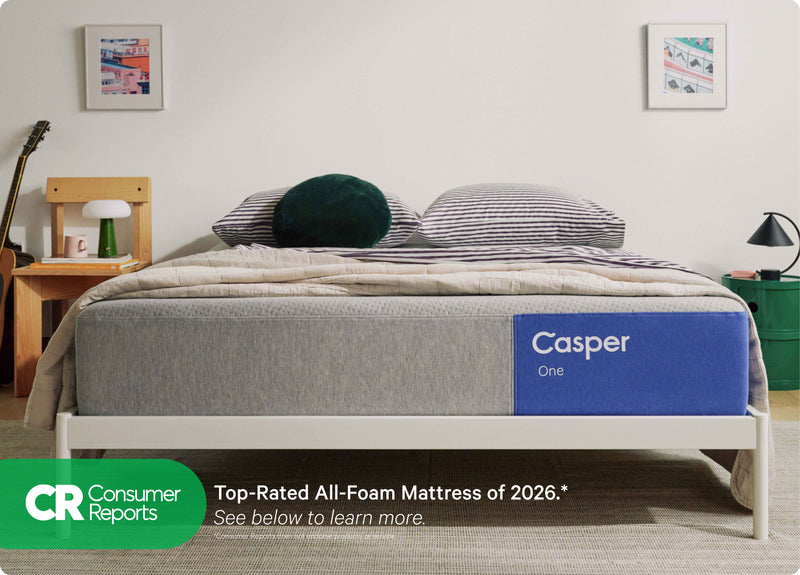
Casper's most popular mattress for good reason: simple three-layer foam construction with zoned support that is firmer under the hips and softer under the shoulders. Reliable, unfussy performance that works across most sleep positions. The clearest weakness is edge support — foam perimeter compresses to 3.2 inches under load, the weakest result in our test group — which reduces usable sleep surface, particularly for larger bodies. At $716 on sale with a 100-night trial, it is the most accessible price point among the picks here. For combination sleepers or light-weight back sleepers who prioritize motion isolation over edge support, it is a sensible choice.
At $899 on sale, the Nectar Premier sits just under $1,000 and closes much of the gap between budget and mid-range. The additional comfort layers provide better shoulder and hip pressure relief than the base Nectar (29 mmHg vs 30 mmHg, and more consistent across sleeping positions). The gel layer moderates some of the heat that is inherent to foam construction. For side sleepers who want the best memory foam experience under $1,000, the Premier is the pick over the standard Nectar — the additional $250 on sale buys meaningfully better pressure distribution, especially for sleepers between 150 and 200 lbs.
Related Reading
Compare top picks side by side →Full ranked list
Best Mattress for Budget Shoppers
See every mattress we tested for budget shoppers, ranked by performance score.
Top Picks for Budget Shoppers
See full list →Ranked by test data

Not sure which mattress is right for you?
Take our 60-second quiz and we'll match you with the best options for your sleep style and budget.
Take the Free Quiz →