Best Mattress When You and Your Partner Have Different Sleep Preferences
Firmness preference, temperature, and sleep position are the three main axes along which partners disagree. Each has a different solution hierarchy, from mattress selection to split configurations. Here is how to work through the compromise systematically.
The most common couple sleep complaint is not motion transfer. It is that one person needs a firm mattress for their back and the other needs soft to avoid shoulder pain. Or one person sleeps hot while the other is always cold. Or one is a side sleeper who needs pressure relief and the other is a back sleeper who needs a flat surface.
These mismatches are not minor preferences. They reflect real physiological differences in body weight, sleep position mechanics, and thermoregulatory baseline. A mattress that is genuinely right for one partner can be genuinely wrong for the other.
The goal of this guide is not to find a compromise that leaves both people mildly unsatisfied. It is to identify which differences have single-mattress solutions, which have workarounds, and which require separate configurations.
Axis 1: Firmness mismatch
Why partners often need different firmness levels
Firmness perception is determined by body weight and sleep position, not just preference. A medium-firm mattress that feels appropriately supportive to a 190-pound back sleeper will feel uncomfortably firm to a 125-pound side sleeper. This is not a subjective difference of opinion. It reflects the physics of load distribution.
A lighter person compresses the mattress surface less, meaning they ride higher on the comfort layers and feel more of the underlying support core. A heavier person sinks deeper, reaching the softer transition layers between comfort and support. The same ILD (indentation load deflection, the standard firmness measurement) produces genuinely different sensory experiences at different body weights.
Research: Pressure mapping studies of couples with significant weight differences on the same mattress found that the lighter partner consistently showed higher interface pressures at the hip and shoulder than the heavier partner on medium-firm surfaces, despite the same mattress. The heavier partner's weight compressed the mattress into the softer range, while the lighter partner remained on the firmer surface layer. (Verhaert V, Ergonomics, 2011)
Sleep position compounds this. A side sleeper needs enough surface softness to allow the shoulder and hip to sink, reducing pressure at those sites. A back sleeper needs a flatter, firmer surface to maintain lumbar support. A mattress that is right for a side sleeper will often be too soft for the back sleeper, allowing the lumbar to sink out of neutral alignment.
Single-mattress solutions for firmness mismatch
Zoned construction. Some mattresses build in softer zones at the shoulder and firmer zones at the lumbar, accommodating side and back sleeping within a single mattress. These work best when both partners are in the similar weight range and the difference is primarily positional.
Dual-sided configurations. A few manufacturers offer couples configurations where each half of the mattress can be ordered at different firmness levels. This is a meaningful option if the weight and position difference is significant.
Comfort layer topper. Adding a 2- to 3-inch soft foam topper on one partner's side of the mattress can address moderate mismatch. The limitation: the topper raises that side's sleeping surface, creating a slight height difference at the center. This is minor for most couples but noticeable for some.
A useful heuristic: If the weight difference between partners is more than 50 pounds, a single-firmness mattress will be genuinely difficult to get right for both. The heavier partner needs a firmer mattress to prevent excessive sinking. The lighter partner needs a softer mattress to avoid pressure peaks. These requirements can directly conflict at large weight differentials.
Axis 2: Temperature mismatch
Why one partner runs hot and the other is always cold
Thermoregulatory baseline varies between individuals and is influenced by body composition, metabolic rate, hormonal status, and individual variation in autonomic nervous system calibration. Women in perimenopause or menopause frequently run hot due to estrogen-related thermoregulatory dysfunction. People with higher muscle mass generate more metabolic heat at rest. Some people are simply calibrated to a warmer baseline regardless of any of these factors.
This creates a specific couples problem: the person who runs cold wants more blankets and may want a warmer sleep surface. The person who runs hot wants fewer blankets and a cooler surface. These needs oppose each other at the blanket level, and at the mattress level, the trade-off is real: any mattress modification that warms the surface for the cold sleeper also warms it for the hot sleeper.
Solving temperature mismatch
The blanket solution. The most effective and most overlooked approach: separate blankets. The Scandinavian method of each partner using their own duvet, rather than sharing a single blanket, allows each person to regulate their individual thermal environment without affecting the other. This works regardless of mattress choice and is free.
The mattress role. The mattress primarily affects the temperature floor (the minimum warmth both partners experience). Choosing a thermally neutral mattress (hybrid or latex over foam) keeps the floor lower, giving the cold sleeper room to add blankets without the hot sleeper starting from an already-warm baseline.
Dual-zone temperature control systems. Devices like the Sleep Number Climate360 or Eight Sleep Pod use water-cooled/heated panels on each side of the mattress to actively regulate each partner's temperature independently. These are expensive additions but effectively solve thermal mismatch without any mattress compromise.
Common misconception: "We just need to agree on a room temperature." Room temperature affects both partners equally and does not address individual thermoregulatory differences. The cold sleeper needs more thermal input than the room provides. The hot sleeper needs less. These are individual requirements that a shared room temperature cannot simultaneously satisfy. Separate blankets and/or a dual-zone system is the only structural solution.
Axis 3: Sleep position mismatch
Side sleepers and back sleepers have directly opposing surface needs at the shoulder and hip. A back sleeper's ideal surface is relatively flat and firm, maintaining spinal neutrality in extension. A side sleeper's ideal surface is soft enough to allow the shoulder and hip to sink below the plane of the torso, maintaining spinal neutrality in lateral flexion.
When a side sleeper and back sleeper share a medium-firm mattress, one of two compromises happens: the mattress is soft enough for the side sleeper, and the back sleeper's lumbar sinks into slight flexion; or the mattress is firm enough for the back sleeper, and the side sleeper gets pressure peaks at the shoulder and hip.
The partial solution: mattresses with zoned softness that are softer in the shoulder zone and firmer in the lumbar zone. When aligned correctly, both partners get appropriate surface characteristics for their respective positions. The limitation is that the zones are fixed, so alignment must be intentional (the side sleeper must sleep with their shoulder in the softer zone).
The full solution: split king
All three of the mismatches above are resolved completely by a split king configuration: two twin XL mattresses in a king frame, each selected and configured independently.
| Issue | Single mattress | Split king |
|---|---|---|
| Firmness mismatch | Partial (zoning, topper) | Complete (each partner chooses) |
| Temperature mismatch | Limited (blankets help) | Complete (independent toppers or dual-zone systems) |
| Motion transfer | Depends on mattress type | Complete (no shared material) |
| Cost | Lower | Higher (two mattresses + frame) |
| Center seam | None | Present (mitigated by bridge) |
Purple's GelFlex Grid provides a distinctly different feel from both foam and coil mattresses: it is simultaneously firm enough to support back sleepers at the lumbar and soft enough to allow shoulder and hip pressure relief for side sleepers. The grid's local compression response means it behaves differently at different load points rather than having a uniform firmness across the surface. This adaptive quality makes it one of the better single-mattress options for couples with position-based firmness mismatches.
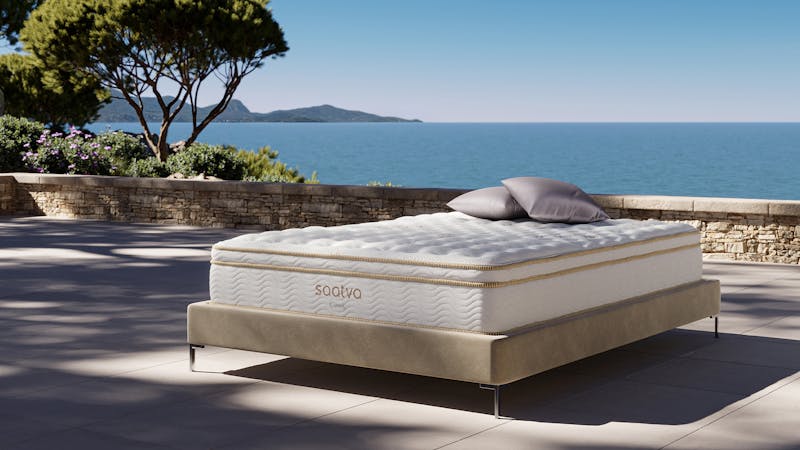
Available in three firmness levels and in all sizes including split king configurations. For couples who have identified a specific firmness need for each partner and want to stay in the same mattress family, ordering two different Saatva Classic firmness levels (one Plush Soft, one Luxury Firm, for example) in a split king frame is a practical solution. The edge support and build quality hold across all firmness options.
The medium-firm pocketed coil hybrid sits in the range that satisfies the widest variety of sleep positions and body weights without strong optimization for any one type. For couples who are uncertain which of the three mismatch axes is primary, and who want a reliable starting point without committing to a split configuration, the DreamCloud Premier is the lowest-risk single-mattress choice for couples with moderate differences.
Related Reading
Full ranked list
Best Mattress for Couples
See every mattress we tested for couples, ranked by performance score.
Top Picks for Couples
See full list →Ranked by test data
Not sure which mattress is right for you?
Take our 60-second quiz and we'll match you with the best options for your sleep style and budget.
Take the Free Quiz →