Why Mattresses Sag Faster for Heavier Sleepers (2026)
Mattress sagging under heavier sleepers is not a manufacturing defect. It is predictable material behavior: sustained higher compressive load accelerates the foam compression set and coil fatigue that cause permanent body impressions.
Body impressions and sagging are the most common mattress complaints. For heavier sleepers, they appear earlier and deepen faster than for lighter sleepers on the same product. This is not a defect in the mattress. It is the predictable result of how foam and coil materials behave under sustained compressive load.
Understanding why this happens tells you exactly what to look for in a mattress to slow or avoid it, and explains why some mattresses perform significantly better than others for heavier sleepers even when both claim to be designed for all body types.
Foam compression set: what it is and why weight accelerates it
Foam is a polymer structure with open cells that compress under load and ideally recover when the load is removed. Over time, this recovery becomes incomplete. The cells permanently deform and lose their ability to return to original height. This is compression set.
Two variables drive how fast compression set develops:
Load magnitude. Higher compressive stress on the foam cells accelerates the rate at which cell walls permanently deform. A heavier sleeper applies more stress per unit area to the foam than a lighter one. The relationship is not linear: doubling the applied stress more than doubles the rate of compression set, because foam cell failure follows an exponential curve above a threshold stress.
Time under load. Compression set accumulates over years of 6 to 8 hour nightly compression cycles. Heavier sleepers hit the threshold stress earlier in each foam product's life cycle, so the impression appears sooner than it would for lighter sleepers using the same mattress.
Research: ASTM D3574 testing subjects foam to repeated compression cycles and measures the percentage of original thickness lost. Testing across foam densities found that low-density foams (1.2 to 1.5 lb/ft³) showed 15 to 25 percent compression set after simulated 10-year use at average loads, but showed 30 to 45 percent compression set under simulated higher loads representing the 90th percentile body weight. High-density foams (1.8+ lb/ft³) showed approximately half the compression set under the same higher-load conditions. (ASTM D3574 comparative testing data)
Common misconception: "Memory foam is more durable because it is denser." Memory foam is denser than standard polyfoam, but its viscoelastic properties make it particularly prone to compression set under sustained higher load. The slow-recovery characteristic that gives memory foam its feel is also what makes it vulnerable to permanent deformation. High-density polyfoam or latex resists compression set more effectively than memory foam under heavier loads.
Coil fatigue in spring systems
Pocketed coil and innerspring systems degrade under load through a different mechanism: metal fatigue. Each compression and recovery cycle places stress on the coil wire at the points of bending. Over many cycles, this produces microscopic cracks in the wire that gradually reduce spring tension.
The rate of coil fatigue depends on load and wire gauge. Higher load per coil accelerates fatigue. Thinner wire (higher gauge number) has less material to absorb the bending stress and fatigues faster. A mattress built with 14-gauge coils for an assumed 180-pound sleeper will experience significantly more fatigue per coil when used by a 280-pound sleeper, because the load per coil exceeds the design assumption.
This is why mattresses designed specifically for heavier sleepers use lower-gauge (thicker) wire: 12 or 13 gauge versus the standard 14 to 16. The thicker wire handles higher load cycles without developing fatigue at the same rate.
Latex as the durability exception: Natural latex is the most durable comfort material under repeated load cycling. Its open-cell structure and polymer chemistry resist both compression set and fatigue failure. Independent durability testing consistently places latex above memory foam and polyfoam for long-term performance, particularly under higher sustained loads. The trade-offs are cost and mattress weight, which makes rotation harder but not impossible with two people.
What to look for to slow sagging
High-density foam layers. Comfort layers should be rated at 1.8 lb/ft³ or higher. Support foam base layers should be at 2.0 lb/ft³ or higher. Ask manufacturers for density specs directly, not just ILD ratings — the two measure different things.
Low-gauge coils. In hybrid mattresses, coil wire gauge should be 13 or lower. Many budget hybrids use 15 or 16 gauge coils that are not rated for sustained higher loads.
Regular rotation. Rotating the mattress 180 degrees every 3 to 6 months distributes wear more evenly and delays the development of a permanent body impression at a single location.
Adequate foundation. A mattress on a sagging or widely spaced foundation transmits sag into the mattress structure regardless of mattress quality. Slatted foundations should have slats no more than 3 inches apart. Platform frames with solid decks distribute load evenly.
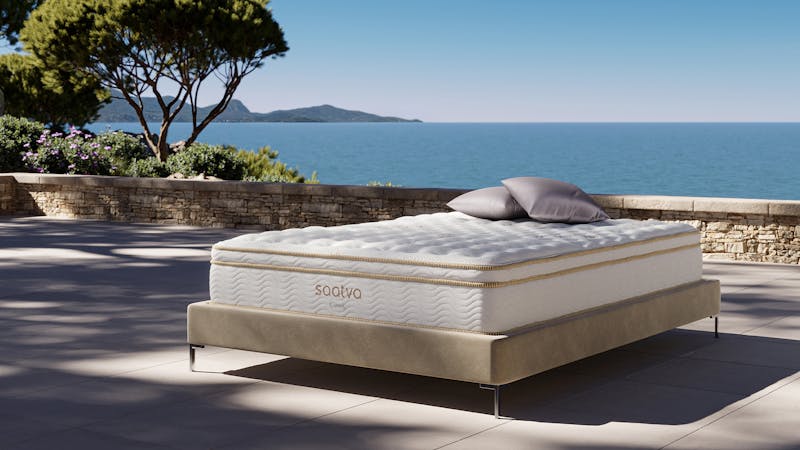
The dual-coil construction uses tempered steel coils that are mechanically more resistant to fatigue than single-coil systems under sustained higher load. The reinforced lumbar zone adds structural density at the highest-load zone. Saatva specifies high-density foam layers and the coil wire gauge is appropriate for a wide weight range. For heavier sleepers concerned specifically about long-term durability, the Saatva's construction is among the most robust in mainstream mattresses.
Natural latex in the comfort layer is the most durable comfort material available. Avocado's Dunlop latex base and Talalay latex comfort layers resist compression set at a level no foam alternative matches, which translates directly into longer effective life at higher body weights. The trade-off is mattress weight, which makes rotation harder but remains important for maximizing lifespan.
The DreamCloud's pocketed coil system and high-density foam layers are better specified for durability than most price-comparable hybrids. The combination of coil support and adequate comfort layer density resists the body impression development that shortens mattress life for heavier sleepers. For the value-conscious heavier sleeper, the DreamCloud Premier's construction quality relative to its price makes it a strong long-term choice.
Related Reading
Full ranked list
Best Mattress for Back Pain
See every mattress we tested for back pain, ranked by performance score.
Top Picks for Back Pain
See full list →Ranked by test data
Not sure which mattress is right for you?
Take our 60-second quiz and we'll match you with the best options for your sleep style and budget.
Take the Free Quiz →