Best Mattress for Neck Pain (2026): How Your Sleep Surface Affects Cervical Alignment
Neck pain during sleep is usually attributed to the pillow, and the pillow is often the primary variable. But the mattress determines how far the shoulder sinks into the sleep surface, which directly sets the angle of the cervical spine. Getting the mattress wrong makes any pillow choice less effective.
Neck pain and sleep have a well-established relationship, but the mechanism is commonly misunderstood. Most people focus entirely on the pillow, and the pillow does matter. But the mattress sets the conditions within which the pillow operates: specifically, how far the shoulder sinks into the sleeping surface determines the height difference between the shoulder and the head, which the pillow then needs to bridge.
If the mattress is too firm for the sleeper's body weight, the shoulder does not sink enough, and the pillow needs to be unrealistically thick to keep the cervical spine neutral. If the mattress is too soft, the shoulder sinks past the point of neutrality, and the head drops into lateral flexion regardless of pillow choice. The mattress and pillow form a system, and getting the mattress wrong limits what the pillow can fix.
How shoulder sink determines cervical alignment
In side sleeping, the weight of the upper body rests primarily on the shoulder. The shoulder is a rounded structure. How far it sinks into the mattress surface determines the elevation of the acromion (the top of the shoulder) above the mattress.
The head, resting on the pillow, needs to be at the same height as the cervical spine in its neutral position. The neutral position of the cervical spine is not a straight horizontal line: it has a natural lordotic curve (inward). But in the lateral plane, the spine should run in a straight line from the thoracic spine through the cervical vertebrae to the skull base.
If the shoulder sinks too little (mattress too firm), the acromion sits high, and the head would need a very tall pillow to reach cervical neutrality. Without that pillow height, the neck drops toward the mattress in lateral flexion, loading the facet joints on the lower side and stretching the muscles on the upper side.
If the shoulder sinks too much (mattress too soft), the acromion drops low, the cervical spine bends toward the mattress surface in the other direction, and the same problem occurs in reverse.
Research: Imaging studies of cervical spine angle across varying mattress firmness and pillow height combinations found that shoulder accommodation by the mattress (allowing adequate shoulder sink) was a more significant determinant of cervical neutrality than pillow height alone. Participants who used the same pillow on a softer mattress achieved significantly better cervical alignment than those using the same pillow on a firm mattress. (Gordon SJ, Journal of Manipulative and Physiological Therapeutics, 2009)
The practical implication: If you have tried multiple pillows and still wake with neck pain in side sleeping, the mattress's shoulder zone compliance may be the limiting factor. The pillow is adjusting for the wrong starting point because the mattress is not allowing the shoulder to reach its natural position.
Back sleepers and neck pain
For back sleepers, the mattress affects neck pain differently. In supine, the shoulder does not bear weight the same way, and cervical alignment depends primarily on the pillow maintaining the natural cervical lordosis above the mattress surface.
But the mattress matters for back sleepers through its effect on the thoracic spine. If the thoracic region sinks into a soft mattress, the upper back rounds into kyphosis, which can produce compensatory cervical extension (the head tips backward to maintain horizontal gaze). Sustained cervical extension compresses the posterior cervical elements.
A mattress that maintains thoracic support (not allowing excessive upper back sinking) combined with the correct pillow height produces better cervical alignment in back sleepers than a soft mattress even with a cervical-contoured pillow.
Stomach sleepers and neck pain
Prone sleeping requires sustained cervical rotation to one side, which is nearly impossible to fully address with mattress choice. The cervical musculature is held in an asymmetric contraction for hours. The mattress contribution is indirect: the flatter (firmer) the surface, the less additional cervical rotation is induced by the face sinking into a soft surface. But no mattress eliminates the fundamental problem of prone cervical rotation.
For stomach sleepers with chronic neck pain, the most important intervention is position change, not mattress selection.
Common misconception: "My neck pain is a pillow problem, not a mattress problem." In side sleeping, the pillow and mattress form a coupled system. The pillow compensates for whatever height the mattress does not provide through shoulder accommodation. Changing the pillow on the wrong mattress is like adjusting one variable in a two-variable equation. Both matter.
The zoned pocketed-coil system is the most relevant structural feature for neck pain: the shoulder zone is specifically designed to be softer, allowing greater shoulder sink, while the lumbar zone is firmer for support. This directly addresses the shoulder accommodation variable that determines cervical angle in side sleeping. For side sleepers with neck pain who have tried multiple pillows without resolution, the shoulder zone compliance of the Midnight Luxe is often the missing variable.
The foam construction allows consistent shoulder sink across the width of the mattress without pressure concentration. For lighter side sleepers (under 150 lbs) who need a softer shoulder zone but are not getting adequate shoulder accommodation from medium-firm hybrids, the Nectar Premier's foam provides a softer baseline that accommodates the shoulder more readily. The gel layer addresses the heat concern inherent to foam beds.
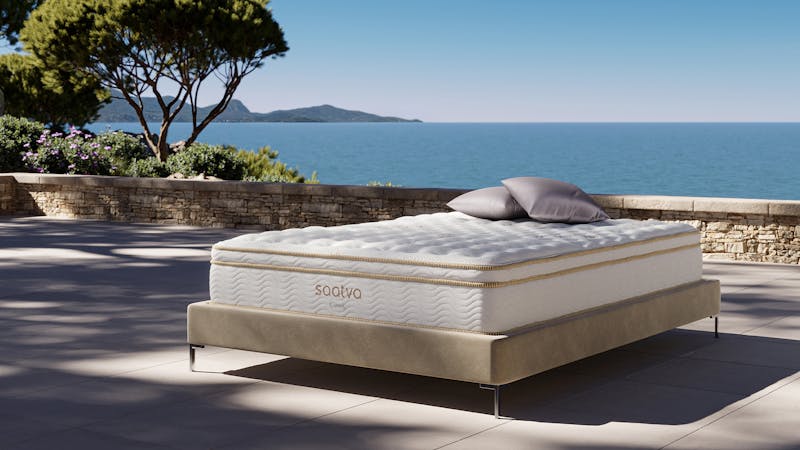
For back sleepers with neck pain, the Saatva's thoracic support (the dual-coil system resists the upper back sinking that causes compensatory cervical extension) is the most directly relevant property. In Luxury Firm, the upper back stays elevated, allowing the pillow to maintain cervical lordosis without fighting a collapsed thoracic baseline. The reinforced lumbar zone additionally prevents the pelvic tilt that can cascade upward into cervical misalignment.
Related Reading
Compare top picks side by side →Full ranked list
Best Mattress for Back Pain
See every mattress we tested for back pain, ranked by performance score.
Top Picks for Back Pain
See full list →Ranked by test data

Not sure which mattress is right for you?
Take our 60-second quiz and we'll match you with the best options for your sleep style and budget.
Take the Free Quiz →