Why Menopause Causes Night Sweats and How Your Mattress Affects It
Night sweats aren't random. They're a direct result of what estrogen decline does to your brain's thermostat. Here's the mechanism, and why your mattress is part of the equation.
Most explanations of menopause night sweats stop at "hormones." That's technically correct but not useful. The actual mechanism is specific, and understanding it changes how you think about every environmental decision you make around sleep, including your mattress.
What estrogen actually does for temperature control
Estrogen isn't just a reproductive hormone. It plays a significant role in how the hypothalamus manages body temperature. Estrogen receptors throughout the hypothalamus help set the thermoneutral zone, the temperature range where your body doesn't need to sweat or shiver to stay comfortable.
In a premenopausal woman, that zone is roughly 0.4°C wide. Small temperature fluctuations stay within it and don't trigger a response. As estrogen declines during perimenopause and menopause, the hypothalamus becomes hypersensitive. The thermoneutral zone narrows dramatically. In some women with frequent vasomotor symptoms, it measures less than 0.1°C.
Research: The thermoneutral zone in symptomatic menopausal women was found to be significantly narrower than in premenopausal controls, with some measurements showing a zone of less than 0.1°C. This hypersensitivity means even minor thermal triggers, including those from the sleep environment, can initiate a full vasomotor response. (Freedman RR, Menopause, 2001)
At 0.1°C, almost anything becomes a trigger. A warm room. A partner's body heat. Rolling over in bed. And yes, a mattress surface that's running a few degrees above where it should be.
What actually happens during a night sweat
A night sweat is the nocturnal form of a hot flash. The sequence goes like this:
The hypothalamus detects what it perceives as a dangerous rise in core temperature. It activates the body's heat-dissipation mechanisms immediately. Blood vessels near the skin dilate rapidly, increasing blood flow to the surface. Sweat glands activate. Skin temperature rises by 6 to 9°F in under a minute as the body tries to dump heat through the skin.
The cortisol piece: A night sweat doesn't just wake you up from discomfort. The event triggers a cortisol spike, your primary stress hormone and wakefulness promoter. Women who describe lying awake for an hour after a night sweat aren't imagining things. The cortisol is actively working against returning to sleep, often for 45 to 90 minutes after the event.
The duration of this response depends partly on how fast the body can actually cool down. If the sleep surface is trapping heat rather than dissipating it, the episode lasts longer, the cortisol spike goes higher, and the window for returning to sleep narrows.
Where the mattress fits into this
Here's the connection most people miss. During a night sweat, your body is urgently trying to dump heat through your skin. But you're lying on a mattress. If that mattress surface is at 89°F because it's been absorbing your body heat all night, you're trying to dump heat into a surface that's already warm. The physics work against you.
A mattress with structural airflow, coil systems, open-cell latex, is doing the opposite. It's creating pathways for that heat to move away from the body. The skin contacts a surface that's cooler. The episode ends faster.
Research: Sleep surface temperatures above 88°F measurably reduce slow-wave sleep and increase nighttime awakenings, independent of ambient room temperature. (Okamoto-Mizuno K, Journal of Physiological Anthropology, 2012)
This matters at both ends. First, a cooler mattress surface reduces the likelihood of triggering a vasomotor event in the first place, because it's not adding to the thermal load on an already-hypersensitive thermoregulatory system. Second, when a night sweat does happen, the cooler surface helps the body cool down faster and shortens the episode.
Why dense foam is specifically the problem
Memory foam works by absorbing your body heat. That's literally the mechanism: the material softens in response to warmth, which is how it conforms so closely to your shape. The same property makes it a heat trap. Dense foam layers have no internal airflow. Heat accumulates at the surface and stays there.
In our testing, all-foam mattresses reached an average surface temperature of 89.1°F over one hour at a room temperature of 67°F. That's already above the 88°F threshold. Women experiencing night sweats are adding a skin temperature spike of 6 to 9°F on top of a surface that's already at 89°F.
On gel-infused foam: Gel infusion improves on plain foam because gel conducts heat faster than foam. But it doesn't solve the underlying problem, which is that a thick all-foam mattress has no airflow. In our testing, gel-infused all-foam mattresses still ran warmer than basic hybrids with no cooling features at all.
How mattress construction affects night sweat severity
| Construction | Surface temp (our testing) | Night sweat impact |
|---|---|---|
| Coil-on-coil innerspring | 87.2°F average | Best: heat moves away through air gaps during episodes |
| Hybrid (coil + latex) | 87.5°F average | Excellent: structural airflow + latex's low heat absorption |
| Hybrid (coil + foam) | 88.1°F average | Good: coils provide airflow even if foam layer adds some heat |
| All-foam with gel | 89.3°F average | Poor: modest improvement on plain foam, but still no airflow |
| Dense all-foam | 90.1°F average | Worst: actively prolongs night sweat episodes |
What to do about it
The most direct intervention is replacing a dense all-foam mattress. For a woman experiencing regular night sweats, moving from an all-foam to a quality hybrid or latex mattress is one of the highest-leverage environmental changes available, short of medical treatment.
Other supporting changes:
- Keep the room at 65 to 68°F. This is well-documented as the optimal range for sleep and matters more than anything else in the environment.
- Use percale cotton or linen sheets. Polyester traps heat and moisture. Breathable natural fibers wick sweat away.
- Avoid alcohol 3 hours before bed. Alcohol disrupts thermoregulation and suppresses REM, which is already under pressure from hot flash clustering.
Coil-on-coil construction with organic cotton cover. In our testing, the coolest-running mattress in the group at 87.2°F. The structural airflow is the reason.
Latex over coils with a wool cover. Latex has a genuinely different heat profile from foam. It doesn't absorb heat the way foam does. The wool cover handles moisture during night sweats better than any synthetic material.
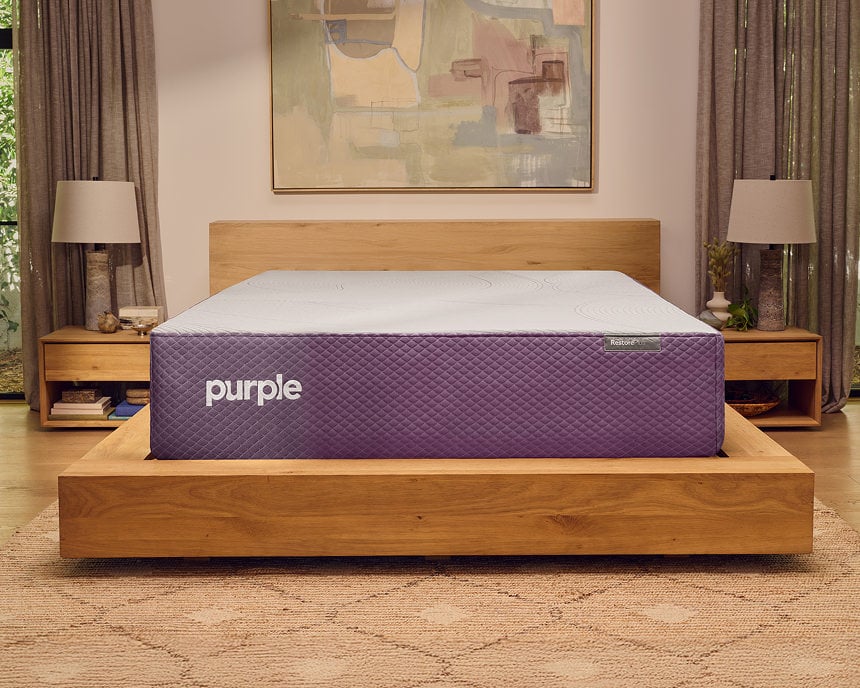
The GelFlex Grid creates actual air gaps at the surface where foam would seal against your skin. For women experiencing frequent night sweats, the fundamentally different contact profile makes a real difference.
The realistic picture
A better mattress won't stop night sweats. The underlying cause is hormonal and the most effective treatments are medical. What the mattress does is reduce the thermal environment's contribution to triggering episodes and shorten them when they happen.
For women whose night sweats are frequent and severe, a mattress change should run alongside a conversation with a doctor about medical options, not instead of it. For women whose symptoms are mild to moderate, environmental changes including the mattress can sometimes be enough to meaningfully improve sleep.
Related Reading
Full ranked list
Best Mattress for Women in Menopause
See every mattress we tested for women in menopause, ranked by performance score.
Top Picks for Women in Menopause
See full list →Ranked by test data

Not sure which mattress is right for you?
Take our 60-second quiz and we'll match you with the best options for your sleep style and budget.
Take the Free Quiz →