Best Mattress for Combination Sleepers (2026): Responsiveness, Support, and Top Picks
Combination sleepers change position multiple times per night and need a mattress that accommodates each position adequately while being responsive enough to make transitions easy. The trade-offs between conforming comfort and responsive movement define the choice.
Most people are not strict single-position sleepers. Studies using mattress-embedded sensors and actigraphy show that even people who describe themselves as "side sleepers" or "back sleepers" often change positions three to six times per night. Combination sleepers are simply those for whom this movement is more pronounced: they regularly spend significant time in two or three distinct positions within a single sleep period.
This creates a specific mattress challenge. Each sleep position has different requirements: side sleeping needs shoulder and hip pressure relief, back sleeping needs lumbar support and a flatter surface, stomach sleeping needs firmness to prevent lumbar sag. A mattress optimized for one of these positions will inevitably compromise at least one other. The combination sleeper's mattress needs to find a range that works adequately across all positions they use, and respond quickly enough to not impede position transitions.
The responsiveness problem with memory foam
Memory foam (viscoelastic foam) is popular for its pressure relief and motion isolation. For strict side sleepers who do not move much, it works well. For combination sleepers, it has a significant drawback: slow response time.
Viscoelastic foam softens with body heat and takes time to return to its original shape after a load is removed. When you roll from your side to your back, the foam that was conforming to your shoulder and hip retains the impression of your previous position for several seconds. You are now lying in a mold shaped for a different position, which creates resistance and discomfort during the transition.
More significantly, the "stuck" sensation of slow-recovery foam is activating for some sleepers. The effort required to reposition can be enough to produce a partial or full awakening rather than a seamless transition through N1 sleep.
Research: Pressure mapping studies comparing mattress materials during simulated position changes found that viscoelastic foam produced significantly higher transition resistance (the force required to initiate a rolling movement) than either latex or pocketed coil surfaces. Transition resistance correlated with polysomnographic arousal events during position changes: higher resistance produced more frequent arousal events per position change. (Verhaert V, Ergonomics, 2011)
Common misconception: "Memory foam is the best for pressure relief, so it must be good for combination sleepers." Pressure relief in a static position and ease of movement through positions are different properties. Memory foam excels at the first and struggles with the second. Combination sleepers benefit from materials that provide adequate pressure relief while remaining responsive enough to move through without effort.
What combination sleepers actually need
Responsiveness. The mattress should return to neutral quickly when load is redistributed. Latex is the most responsive common mattress material: it deforms under load and springs back immediately when the load shifts. Pocketed coil systems are also responsive because each coil independently responds to load changes.
Medium firmness. The widest range of positions are accommodated by medium firmness (ILD 25-31 approximately). Firm enough to prevent lumbar sag in back and stomach positions, soft enough to relieve shoulder and hip pressure in side positions. The edges of this range may not be perfect for any single position but are adequate across all of them.
Zoning helps. Mattresses with softer zones at the shoulder and firmer zones at the lumbar perform well for combination sleepers because they provide position-appropriate firmness without requiring the sleeper to choose between side-sleeping and back-sleeping optimization.
Adequate edge support. Combination sleepers often position themselves near the edge during position transitions. Weak edge support creates a roll-off sensation that can trigger a waking.
The latex advantage: Natural latex is uniquely well-suited to combination sleepers. It provides more pressure relief than firm foams or coils (useful in side positions), responds immediately to load changes (useful during transitions), and does not develop the body-impression problem that foam beds accumulate over time. The downsides are weight, heat (latex runs warmer than coil hybrids), and price.
Side-to-back transition: the most common combination
The most common combination is side and back sleeping. This pairing has partially compatible requirements: side sleeping needs soft shoulders, back sleeping needs lumbar support. These can coexist in a zoned mattress where the shoulder zone is softer and the lumbar zone is firmer. The hip zone needs to be moderate: soft enough for side sleeping pressure relief, firm enough to prevent excessive sinking in back sleeping.
A medium-firm mattress with zoned construction handles this combination better than a uniform-firmness mattress of any ILD.
Side-to-stomach transition: the hardest combination
Side and stomach is the most difficult combination because their requirements are most opposed. Side sleeping wants softness; stomach sleeping wants firmness. There is no firmness level that is genuinely optimal for both.
The practical approach is to prioritize stomach sleeping support (go firmer) and use a thinner pillow to manage the cervical rotation issues that come with prone sleeping. The shoulder and hip pressure in side sleeping will be more than ideal but manageable with a firmer surface that still has some comfort layer.
The GelFlex Grid is the most responsive surface material available and is uniquely suited to combination sleepers for this reason. The open grid structure compresses locally under load and returns immediately when the load redistributes. There is no memory effect and no transition resistance. The grid provides pressure relief in side positions (it collapses under bony prominences) while remaining supportive in back and stomach positions (the grid walls provide resistance to full collapse). For combination sleepers whose primary complaint is feeling stuck or having to work to reposition, this is the most direct solution.
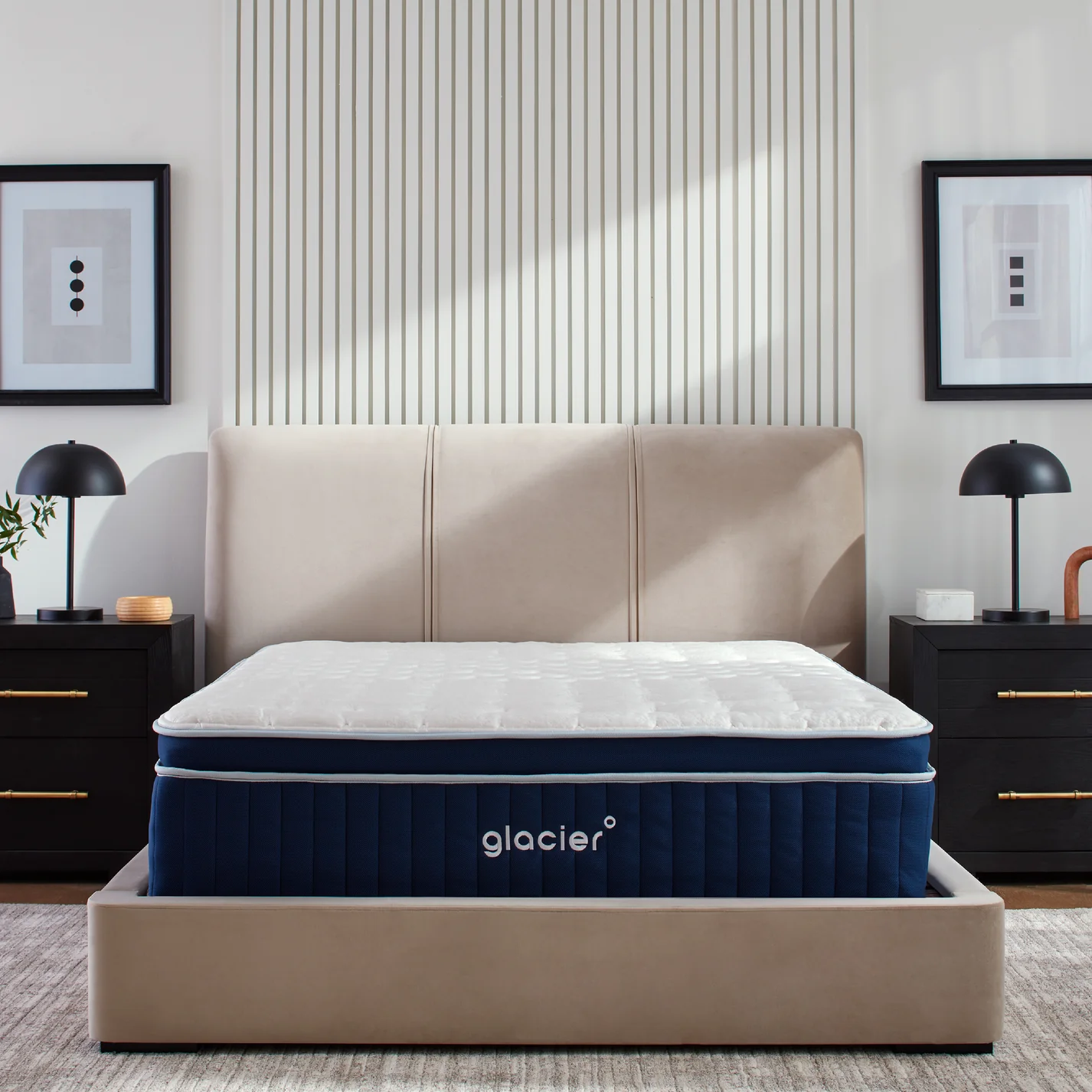
The dual-coil system provides the responsiveness of a spring surface, and the reinforced lumbar zone provides position-appropriate firmness variation without compromising side sleeping comfort. In Luxury Firm, the surface feel accommodates side, back, and moderate stomach sleeping. The strong edge support is a consistent benefit for combination sleepers who move around. The coil-on-coil construction also runs cooler than foam alternatives, which matters since combination sleepers disturb their own thermal microclimate more frequently through movement.
The pocketed coil base provides meaningful responsiveness and the cashmere euro top sits in the medium-firm range that works across positions. For combination sleepers who share a bed and want motion isolation alongside the responsiveness needed for their own transitions, the DreamCloud Premier balances both. The pocketed coil dampens partner motion while the responsive surface allows the sleeper themselves to transition without resistance.
Related Reading
Compare top picks side by side →Full ranked list
Best Mattress for Side Sleepers
See every mattress we tested for side sleepers, ranked by performance score.
Top Picks for Side Sleepers
See full list →Ranked by test data
Not sure which mattress is right for you?
Take our 60-second quiz and we'll match you with the best options for your sleep style and budget.
Take the Free Quiz →