Best Mattress for Menopause Hot Flashes (What Actually Works)
A hot flash isn't just feeling warm. It's a full vascular event that spikes your skin temperature by up to 9°F in under a minute. Your mattress either makes it survivable or makes it so much worse. Here's what we found actually helps.
A hot flash feels like your internal thermostat broke. One second you're fine, the next you're kicking off the covers and sweating through your shirt at 2am. It passes in a few minutes but by then you're wide awake, your heart's going, and the mattress beneath you feels like a heated blanket you can't escape.
The mattress piece of this is more important than most people realize.
What's actually happening during a hot flash
A lot of women think of hot flashes as just "getting warm." The mechanism is more specific. During menopause, declining estrogen disrupts the hypothalamus, the part of your brain that controls body temperature. It becomes hypersensitive to tiny changes in core temperature, treating small fluctuations as emergencies. The result: blood vessels near the skin dilate suddenly, your skin temperature can spike by 6 to 9°F in under a minute, and your body dumps heat as fast as it can.
Research: Estrogen receptors in the hypothalamus directly regulate the thermoneutral zone, the temperature range in which your body stays comfortable without sweating or shivering. As estrogen declines, this zone narrows significantly, making hot flashes more frequent and more severe. (Freedman RR, Menopause, 2014)
The bed you're sleeping on is either releasing that heat or trapping it. If it's trapping it, your skin temperature stays elevated longer after a flash, and your chances of falling back asleep go down substantially.
Why your mattress is making this harder
Your core body temperature needs to drop by about 1 to 2°F to initiate and maintain sleep. Your mattress is supposed to help by allowing heat to dissipate away from your body. Dense memory foam is particularly bad at this. It absorbs heat because that's literally how it works. It softens in response to warmth, which is why it conforms to your shape. During a hot flash, you're generating a heat spike that needs somewhere to go, and memory foam holds it right at the surface.
Research: Sleep surface temperatures above 88°F (31°C) measurably reduce slow-wave sleep and increase nighttime awakenings, regardless of ambient room temperature. (Okamoto-Mizuno K, Journal of Physiological Anthropology, 2012)
Core Body Temperature During Sleep — Normal vs. With Hot Flashes
Core body temperature needs to drop 1-2°F to initiate sleep. During menopause, hot flash spikes interrupt this curve — and each spike triggers cortisol that makes it harder to return to sleep.
What actually makes a difference
| Feature | Impact | Why |
|---|---|---|
| Coil / innerspring base | High | Open air space inside structure allows heat to circulate and disperse |
| Natural latex comfort layer | High | Doesn't absorb heat the way foam does, less surface contact |
| Organic cotton or Tencel cover | Medium | Breathes and wicks moisture; polyester traps both |
| Wool cover | Medium-high | Natural moisture manager, pulls sweat away from skin |
| Cooling gel infusion | Low-medium | Real but modest improvement; doesn't solve structural heat trapping |
| "Cool-to-touch" PCM cover | Low-medium | Initial sensation only on cheap versions; better on quality builds |
Common misconception: "Cooling gel memory foam will fix my hot flashes." Gel infusion helps at the margins. It conducts heat faster than plain foam, but it doesn't fix the underlying structural problem. A thick all-foam mattress still has no airflow. The mattress underneath the gel is still absorbing and holding heat near your body.
The mattresses that actually perform well
The coil-on-coil construction is as close to guaranteed airflow as you get in a mainstream mattress. In our temperature testing it consistently runs 1.5 to 2 degrees cooler than comparable hybrid mattresses. The organic cotton cover breathes. First recommendation for hot flashes specifically.
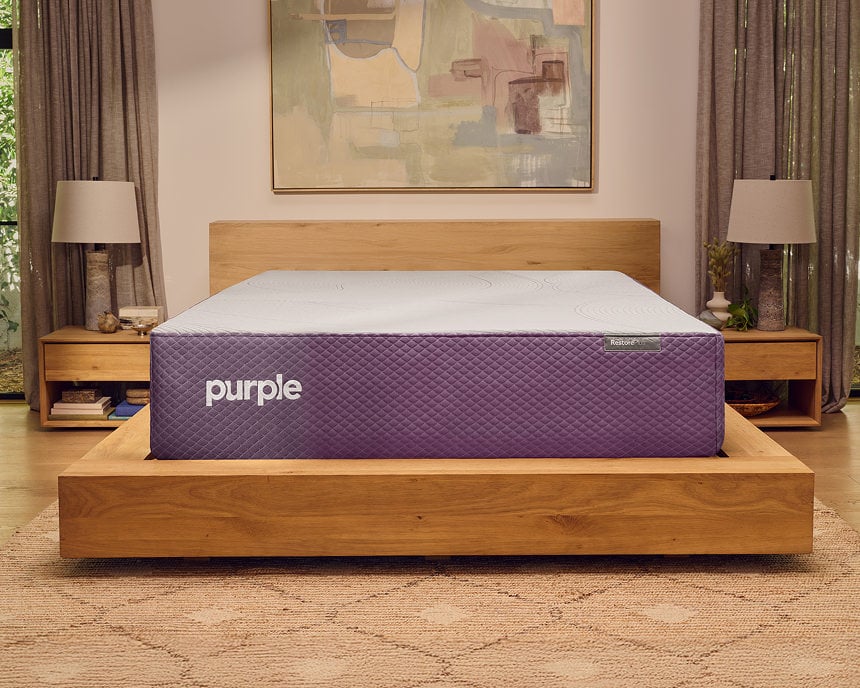
The GelFlex Grid is genuinely different from foam. It deflects under pressure and supports around it rather than compressing against your body. Less skin contact means less heat transfer. Women who've tried every "cooling foam" option without success often find Purple actually solves the problem because the mechanism is fundamentally different.
Latex over coils with a wool and organic cotton cover. Every layer working in the same direction. The latex sleeps cooler than foam, the coil base provides airflow, and the wool cover handles moisture. Strong option if you care about what the mattress is made of.
For women who want maximum cooling without any foam. 100% natural Talalay latex, both sides, flippable. Sleeps noticeably cooler than hybrids in warm rooms. If heat is your primary issue, this is the most direct solution.
What won't help much
A cooling mattress topper on top of a hot all-foam mattress is mostly wasted money. You're adding another foam layer that traps heat between it and the mattress underneath. A good topper might give you an hour before it warms up.
If you're still sleeping hot in a hybrid or latex mattress, look at your sheets before blaming the mattress. Polyester sheets are heat traps. Percale cotton or linen make a real difference. Same with mattress protectors. Most are polyester and counteract whatever cooling properties the mattress itself has.
Room temperature sets the ceiling on all of this. A 75°F bedroom is a 75°F bedroom regardless of what mattress you're in. The mattress helps most in the 65–68°F range where it can actually pull heat away.
Related Reading
Full ranked list
Best Mattress for Women in Menopause
See every mattress we tested for women in menopause, ranked by performance score.
Top Picks for Women in Menopause
See full list →Ranked by test data
Not sure which mattress is right for you?
Take our 60-second quiz and we'll match you with the best options for your sleep style and budget.
Take the Free Quiz →